Monday, December 2, 2013
APOD #5

APOD #4

Sunday, November 28, the comet ISON was seen in predawn skies. The comet has increased activity with a much more complex tail, allowing for naked-eye observation in dark skies. The tail reaches just over 2 degrees in the night sky. In the negative view of the comet, one can accurately observe the tail, which has separated filaments. This is the first time ISON has come to the inner solar system, and may possibly join the December night skies.
Tuesday, October 29, 2013
Observations: Stargaze
Date: October 29, 2013
Time: 7:00 - 8:45 PM
Place: Casey Key Fish House Parking Lot
Sky Conditions: mostly clear, a few clouds overhead and along the horizon. Moon not present.
Instruments used: binoculars and telescope (8 in scope with 9mm and 26mm focal length lenses)
Planets: Venus (viewed in the telescope at a waxing gibbous phase with 9mm focal length lens and 26mm focal length lens)
Bright Stars Noted: Vega, Deneb, Altair, (summer triangle overhead), Antares, Polaris, Fomalhaut
Constellations Noted: Lyra, Cygnus, Aquila, Hercules, Sagittarius, Picis Austrinus, Capricornus, Cassiopeia (learned what "worm" asterism meant)
Binary Stars: epsilon Lyrae (brighter as yellow, other as indigo with 26mm focal length) , Polaris (Polaris B located at 11 o'clock with 26mm focal length lens)
Deep Sky Objects: M57 (the ring nebula in Lyra: a faint ovular smoke ring) , M27 (in Vulpecula), M11 (in Scutum), M13 (globular cluster in Hercules, fuzzy round patch). All viewed with 26mm focal length lens
Other: learned what "worm asterism" means, saw one shooting star (though there were many to be seen), saw the ISS disappear into Earth's shadow, noted that Cygnus at Casey Key Fish House gave us a 4-5 magnitude area
Time: 7:00 - 8:45 PM
Place: Casey Key Fish House Parking Lot
Sky Conditions: mostly clear, a few clouds overhead and along the horizon. Moon not present.
Instruments used: binoculars and telescope (8 in scope with 9mm and 26mm focal length lenses)
Planets: Venus (viewed in the telescope at a waxing gibbous phase with 9mm focal length lens and 26mm focal length lens)
Bright Stars Noted: Vega, Deneb, Altair, (summer triangle overhead), Antares, Polaris, Fomalhaut
Constellations Noted: Lyra, Cygnus, Aquila, Hercules, Sagittarius, Picis Austrinus, Capricornus, Cassiopeia (learned what "worm" asterism meant)
Binary Stars: epsilon Lyrae (brighter as yellow, other as indigo with 26mm focal length) , Polaris (Polaris B located at 11 o'clock with 26mm focal length lens)
Deep Sky Objects: M57 (the ring nebula in Lyra: a faint ovular smoke ring) , M27 (in Vulpecula), M11 (in Scutum), M13 (globular cluster in Hercules, fuzzy round patch). All viewed with 26mm focal length lens
Other: learned what "worm asterism" means, saw one shooting star (though there were many to be seen), saw the ISS disappear into Earth's shadow, noted that Cygnus at Casey Key Fish House gave us a 4-5 magnitude area
Friday, October 18, 2013
Color Acuity Test

Thursday, October 17, 2013
More observations
This past weekend I was at the beach at night (approx. 9 PM) and I was out for about 2 hours. I saw Venus, as usual, among the stars of Scorpion. I saw a piece of Lyra that I hadn't been able to see from my house, as well as a much more visible summer triangle. I was able to identify Polaris for the first time, because the trees near my house usually cover it. I was out long enough to see the circumpolar constellations move a little. I saw Ophiuchus and how big it was (a lot bigger than I expected). I used the method of star-hopping to "follow the arc" to Arcturus when I first got to the beach and identified some nearby stars.
In addition to the hours from the weekend, I observed about an extra two hours throughout this week. Wednesday at 6 PM I was headed east in my car and I saw the moon straight ahead, closer to the horizon than overhead (risen for probably 2-3 hours) and I noticed how large the waxing gibbous moon was when closer to the horizon.
I've also been tracking Venus's movement in comparison to Antares and it seems that Venus is moving along the ecliptic above Antares, or maybe Scorpion is about to set.
In addition to the hours from the weekend, I observed about an extra two hours throughout this week. Wednesday at 6 PM I was headed east in my car and I saw the moon straight ahead, closer to the horizon than overhead (risen for probably 2-3 hours) and I noticed how large the waxing gibbous moon was when closer to the horizon.
I've also been tracking Venus's movement in comparison to Antares and it seems that Venus is moving along the ecliptic above Antares, or maybe Scorpion is about to set.
Sunday, October 13, 2013
Observations from the weekend
Friday night, I observed at a different time than I normally do. Generally, I observe the night sky pretty early--around 9:00. Friday, I was out until about midnight, so I got a different view of the night sky from my driveway. When I looked up, I saw Picis Austrinus when normally, the summer triangle is overhead. Also the moon, at first quarter, had the was split horizontally with the lit side on the bottom, which was also different from what I normally see: a split vertically lit right first quarter. Sunday, in the early evening at around 8, I noticed the start of the waxing gibbous with the lit side on the top rather than the right again. It dawned on me (hah) that the lit side of the moon moves in a circular motion as it moves across the sky rather than staying in one position.
This week I observed about an hour throughout the week.
This week I observed about an hour throughout the week.
Friday, October 11, 2013
Observation
While I've been driving at night, I've been observing the position of Venus whenever I'm driving westward it is to my left, just above the trees. I've also identified Cassiopeia and the summer triangle's bright stars: Altair, Vega, and Deneb. I can't really see the rest of the constellations that make up the summer triangle from my house, but last night I identified Cygnus. All of my observations have been naked eye in my driveway with the help of StarWalk on my phone to confirm my observations. I also noticed last night at around 8:30 that we're approaching the first quarter phase of the moon.
This week I observed approximately 3 hours collectively, collecting the time from both this weeks and past weeks of the quarter, observing the same things without precise logging.
This week I observed approximately 3 hours collectively, collecting the time from both this weeks and past weeks of the quarter, observing the same things without precise logging.
Thursday, October 10, 2013
James Bradley
James Bradley was
an English astronomer who lived from 1693-1762. He is known for
discovering the first direct proof that the earth revolves around the
sun by observing the change in starlight and the nutation of its
axis. He studied at Balliol College, Oxford, and received his
bachelor's and master's degrees from there (HowStuffWorks).
He learned
astronomy first from his uncle, Reverend James Pound, rector at
Wanstead, near London. Pound supported Bradley financially for
thirteen years and took care of him when he got small pox in 1717.
When Bradley was in his twenties, he and Pound were hired by
astronomers Isaac Newton and Edmond Halley to observe astronomical
objects. Together they observed, with great accuracy, the eclipses of
Jupiter's satellites, the diameter of Venus (with a 212 foot long
telescope), and the parallax of Mars (Hirshfeld).
After Bradley
worked for several years for Newton and Halley, Halley endorsed his
election to the Royal Society in 1718 and Newton recommended him to
be the appointed Savilian Professor of Astronomy at Oxford in 1721
(HowStuffWorks). Before then, he was a reverend (Greenwich). In 1724,
Bradley's uncle died and he acquired a new partner in observation:
Samuel Molyneux. This led to the great discovery of the way starlight
changes by observing England's most overhead star, Gamma Draconis
(Hirshfeld). He worked at Molyneux's private observatory in Kew. He
viewed apparent displacement in the star's position annually, leading
to the discovery of the star's aberration (Greenwich). He could not
detect any parallax because the star was too far away, but he noted
that Gamma Draconis shifted south by 1” of arc in three days, which
is in the wrong direction and too large of an amount to be parallax.
Bradley concluded that the phenomenon was a “result of the finite
speed of light and the forward motion of the Earth in its orbit.”
His research confirmed the velocity of light to be 295,000 km/s,
giving proof to Copernican theory (Hawkins).
In 1742, Bradley
succeeded Halley as astronomer royal, the chief astronomer of
England. He was given a grant of 1,000 pounds for more precise
instruments, which he used to determine the latitude of the Royal
Greenwich Observatory (HowStuffWorks). He put in a transit instrument
in the Observatory, which remained there until it was replaced by
Pond in 1816. The line that this transit circle is on is called the
Bradley Meridian, which is used in the Ordinance Survey and is
different from the Airy Meridian that Greenwich Mean Time is measured
(Greenwich).
Hawkins,
Gerald S. "James Bradley (English Astronomer)."
Encyclopedia
Britannica Online.
Encyclopedia Britannica, n.d. Web. 10 Oct. 2013.
<http://www.britannica.com/EBchecked/topic/76818/James-Bradley>.
Hirshfeld,
Alan.Parallax:
The Race to Measure the Cosmos.
New York: W.H. Freeman and, 2001. Print.
Pages 153-154.
"James
Bradley." Greenwich
England:.
N.p., n.d. Web. 10 Oct. 2013.
<http://wwp.greenwichengland.com/heritage/people/astronomers/bradley.htm>.
"James
Bradley" 23 April 2009. HowStuffWorks.com.
<http://science.howstuffworks.com/dictionary/famous-scientists/astronomers/james-bradley- info.htm>
10 October 2013.
Sunday, October 6, 2013
Friday, September 27, 2013
APOD #3
Friday, September 20, 2013
APOD #2
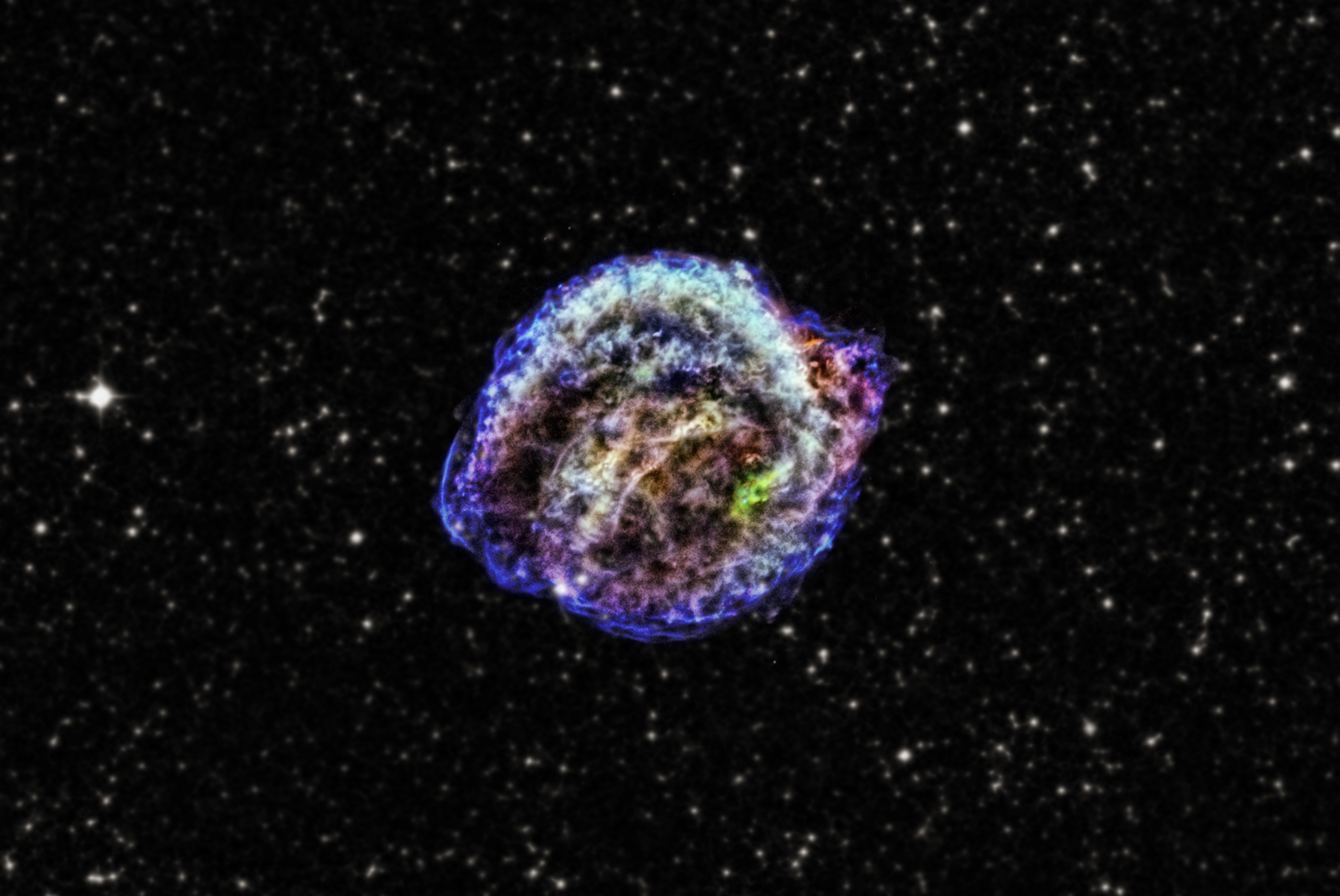
Kepler's Supernova Remnant received some attention from NASA on May 15th, 2013 due to the x-ray data and photographs from the orbiting Chandra X-Ray Observatory. It had long been speculated of what kind of supernova it was. First observed by Johannes Kepler in 1604, a brighter-than-normal star appeared in the night sky in the constellation Ophiuchius and only the second supernova to be observed (the first being the supernova in Cassiopeia by Tycho Brahe). It nas now been revealed that Kepler's Supernova Remant is a Type Ia supernova, previously being a white dwarf star that had sucked in too much material from a companion red giant. This supernova is about 13,000 light-years away and is known as the most recently observed supernova.
Friday, September 13, 2013
APOD #1

Subscribe to:
Posts (Atom)